


Tile Explorer - Triple Match
Oakever Games
Tile Explorer - Triple Match is the kind of puzzle game I can open for a few minutes and still feel that I have made progress. The basic idea is easy to understand: clear groups of three matching tiles from a crowded board before the available spaces become a problem. What makes it more interesting than a simple matching exercise is the need to plan several moves ahead while the useful tiles are partly covered. I found myself switching between quick matches and cautious decisions depending on how much of the board was visible.
Developed by Oakever Games, this free puzzle game is aimed at a broad audience and carries an Everyone age rating. It is available for devices running Android 7.0 or later, and its current version is 1.67.1. The game has attracted over 100 million installs, with a 4.9 average from around 1.4 million ratings and about 6,600 written reviews. Those figures suggest a very large and generally enthusiastic player base, but they do not remove the need to understand how the game actually feels during ordinary play.
How I approach a normal board
My usual workflow starts with a short scan rather than an immediate tap. I look for tiles that are already exposed and identify whether a possible trio is spread across the board or concentrated in one area. Taking the first obvious match can be satisfying, but it is not always the best opening. Sometimes that move exposes a more useful tile; sometimes it fills the holding area with pieces that do not yet have a partner.
Related News

How Tile Explorer - Triple Match Reflects Our Digital Order Obsession

Why DOP 4: Draw One Part is Captivating Puzzle Fans Everywhere
Why Tile Explorer - Triple Match Is the Puzzle Game of the Moment
The central habit is to treat the temporary tile area as limited working space, not as a place to store everything I might need later. When I see two matching tiles, I try to remember where the third could appear after another layer is removed. If the third tile is buried, I weigh the value of opening that section against the risk of occupying another slot. This small pause is where the game becomes a genuine puzzle instead of a reflex exercise.
For a relaxed session, I do not try to solve the entire board in my head. That would make a casual game feel like homework. Instead, I keep one immediate trio in mind and one possible follow-up. This is enough to avoid many careless moves while keeping the pace comfortable. Players who enjoy visual sorting will probably settle into this rhythm quickly, while people who prefer fixed rules and exact solutions may find the changing tile layouts less predictable.
Related News

Why WhatsApp Messenger Still Makes Everyday Communication Feel Easy

Jurassic World: The Game Is the Better Dino Tycoon for Strategic Players

Threads in Real Life: Who Should Join, Lurk, or Leave

How SHEIN Turned Shopping Into an Endless Content Feed

How to Make Fortnite Feel Smarter on Mobile

Should You Switch to Microsoft Outlook on Mobile?
A realistic use case is a short break between errands or while waiting for an appointment. I can play one board without needing a long setup, and the touch controls make the interaction direct. It is also suitable for winding down in the evening because the rules are simple enough to pick up without reading a manual. The trade-off is that a supposedly short session can become longer when I am close to clearing a difficult arrangement and want to try one more time.
What makes the basic loop work
Every move has two effects: it removes tiles when a trio is completed, and it changes which pieces become available. I pay attention to the second effect more than I did at first. A match that clears space but reveals an awkward tile may be less useful than a move that opens a promising section. This is especially important when several exposed tiles look equally attractive.
I also avoid building a plan around a single hidden assumption. If I need one particular tile to appear, I consider that plan fragile. A safer approach is to keep two possible routes open, using exposed matches to reveal more of the board before committing. This is one of the most useful habits for new players because it reduces the number of situations where a board feels lost simply because the first plan failed.
Gallery
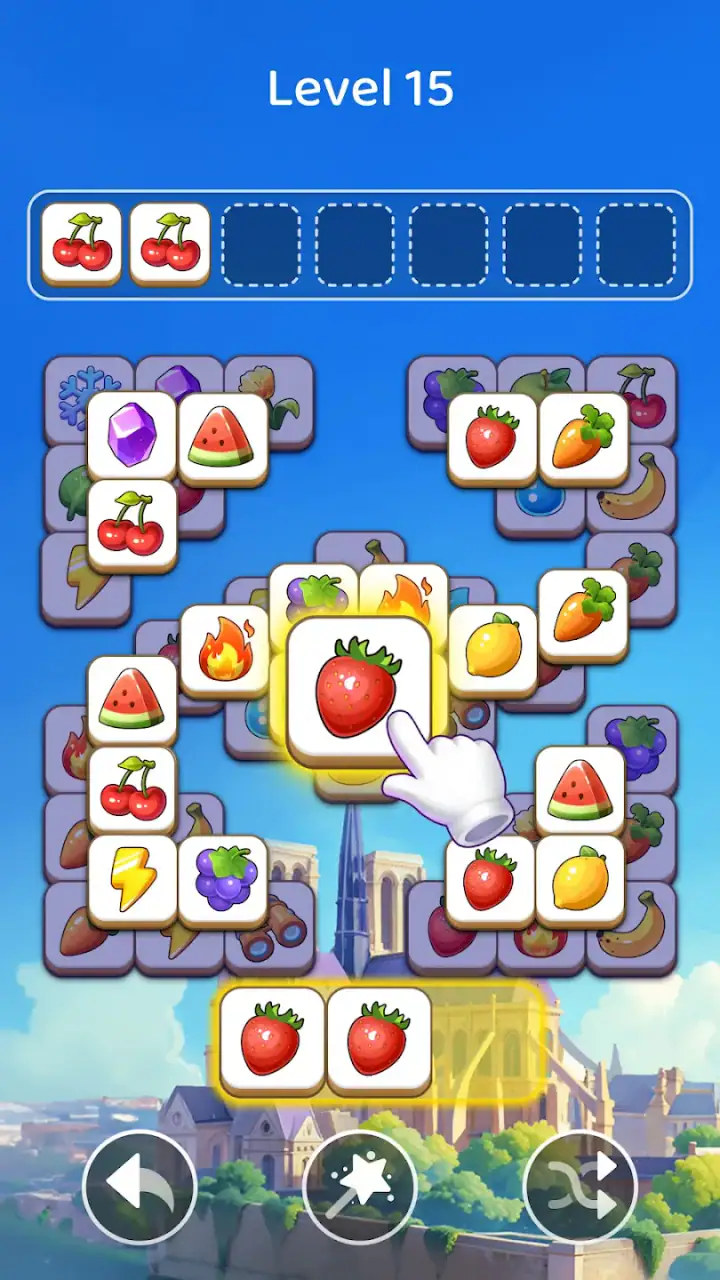
The game is more forgiving when I slow down before filling the available spaces. Rapid tapping can create a chain of individually reasonable choices that becomes collectively bad. I recommend grouping the visible tiles mentally by symbol or image, then checking which groups can be completed immediately. After that, I look for moves that uncover the most useful information rather than merely removing the easiest piece.
That workflow also explains why I would not recommend this game to everyone. If you want a puzzle that rewards speed above all else, a classic timed matching game may be a better fit. Tile Explorer - Triple Match is more enjoyable when you accept a brief planning phase. Its appeal comes from managing uncertainty and space, not from tapping as quickly as possible.
Settings and small habits worth checking
I make a point of checking the available settings before settling into regular play. Even when the rules are straightforward, settings can affect how comfortable a game feels during longer sessions. I look for options related to sound, music, notifications, and other presentation choices, then adjust them to match the situation. For a quiet public place, I prefer a less distracting setup; at home, I may leave more of the audio experience enabled.
It is also worth checking the game after an update rather than assuming every preference remains exactly as before. The current version is 1.67.1, so keeping the app updated can matter for compatibility and general smoothness. I would not treat an update as a reason to change a successful solving routine, but I do revisit the controls and presentation settings if the game feels different after installing one.
My most useful “shortcut” is not a button. It is a repeatable visual scan. I check the board in the same order each time: immediate trios, pairs with a likely third, then blocked areas that could be opened. A consistent scan prevents me from repeatedly rediscovering the same options. It also makes mistakes easier to diagnose because I can tell whether I missed a match or misjudged the value of revealing a tile.
Another practical habit is separating comfort settings from strategy. If the board feels visually busy, I do not compensate by tapping faster. I first make the display and audio easier for me to read, then return to the puzzle. This matters for players who use the game during commutes or in bright rooms, where reflections and interruptions can make an otherwise manageable board harder to follow.
Because the game is free to download, it is easy to try without an upfront purchase. It includes in-app purchases ranging from $0.99 to $44.99 per item, so I recommend deciding in advance whether you want to play strictly within the free experience or are comfortable spending on optional items. My own preference is to treat purchases as a convenience rather than part of the solving method. If a board only feels enjoyable when extra help is available, the underlying challenge may no longer be satisfying.
Faster patterns that do not sacrifice control
Once the basic workflow becomes familiar, I start looking for patterns instead of isolated matches. One pattern is the “release move”: a match chosen mainly because it exposes several new tiles. This is useful when the board has a dense covered section and the visible options are poor. The best release move is not necessarily the largest-looking group; it is the one that improves the next decision without filling the working area too aggressively.
A second pattern is the “reserve pair.” When I find two matching tiles but cannot see the third, I remember their location and avoid taking unrelated tiles that would consume too much space. I do not always preserve the pair, because waiting too long can be just as harmful as acting too soon. The point is to turn the pair into a deliberate possibility rather than an accidental burden.
I also try to complete a trio before creating another unfinished group whenever the board allows it. Unfinished groups compete for space, while a completed trio removes its tiles and gives me a cleaner position. This sounds obvious, but it is easy to ignore when several attractive symbols are visible. The practical rule I use is simple: finish what can be finished, unless doing so blocks a much better opening move.
Players who want to improve quickly should pay attention to the reason behind each failed board. Was the problem caused by taking a pair too early, overlooking an exposed trio, or opening a section without a follow-up plan? I find that reviewing the last few decisions is more useful than blaming the final crowded state. The board usually became difficult several moves earlier.
There is also a pacing advantage to using a deliberate scan. It reduces accidental taps and makes the game feel faster because fewer moves need to be undone or reconsidered. I can move quickly through obvious trios, then slow down only when the board contains competing options. That flexible rhythm is better than playing every move at the same speed.
Compared with traditional match-three games, this format feels less dependent on arranging pieces into lines or creating chain reactions. Compared with a basic memory-matching game, it asks for more spatial planning because the tiles are layered and the available space matters. A standard mahjong-style matching game may feel more methodical, while this one can be more immediate because groups of three are the main target. I prefer Tile Explorer when I want a puzzle that sits between casual sorting and careful board management.
Where experienced play reaches its limits
The game’s simplicity is both its strength and its limitation. The rules are accessible, but repeated play can expose how much the experience depends on the layouts and progression available at the time. If you want a deep strategy system with many radically different rule sets, this is not the right destination. Its challenge comes from applying the same core idea to changing arrangements, not from learning a large collection of mechanics.
There is also a natural tension between planning and uncertainty. I can make a careful decision and still end up with an awkward board because the next useful tile is not immediately available. That is not necessarily a flaw; it is part of the pressure. However, players who dislike situations where a good plan can be disrupted may prefer a logic puzzle with a fully deterministic path.
Long sessions can feel repetitive if I approach every board in exactly the same way. The solution is not to invent rules that are not present, but to vary the goal of each session. Sometimes I focus on clean, cautious play. Other times I practice identifying release moves or reducing unnecessary reserve pairs. This gives the familiar loop a small learning dimension without pretending that the game is a complex strategy title.
I would also be cautious about playing when tired. The individual moves are easy, but fatigue makes me grab the first visible pair and forget the space it will occupy. A short pause before committing to a move is surprisingly valuable. If I am too distracted to scan the board, a different casual game may be more relaxing that day.
The Everyone rating makes the game broadly approachable, and the straightforward rules are suitable for players who do not usually play demanding puzzle titles. Still, “easy to start” does not mean every board will feel effortless. Younger players may enjoy the matching aspect, while older players who like visual organization may appreciate the planning. For anyone who finds layered boards frustrating or has difficulty distinguishing similar tile designs, the experience may be less comfortable, especially during extended sessions.
Who should download it
I think this is a strong choice for someone who wants a free puzzle game that can be understood immediately but still rewards better habits. It works well for short breaks, quiet solo play, and anyone who enjoys sorting visual information under mild pressure. The large install base and high average rating show that the format has broad appeal, although I would still judge it by your preferred puzzle style rather than popularity alone.
I would skip it if your ideal game requires a story, a competitive leaderboard focus, elaborate character progression, or a wide range of entirely different mechanics. I would also look elsewhere if you dislike in-app purchase prompts or prefer games with no optional spending at all. In that case, a paid puzzle app with a fixed structure may offer a cleaner experience, even if it has less of the quick, repeatable appeal found here.
For new players, my advice is to begin slowly and resist the urge to clear every obvious tile immediately. Look for a trio, then ask what the move reveals and how much space it consumes. After a few boards, start tracking pairs that may become useful and practice choosing release moves. Those habits improve decision-making without requiring memorization or complicated notation.
For experienced players, the best challenge is consistency. Try to reduce avoidable mistakes rather than chasing speed. A fast board completed through lucky taps does not teach as much as a carefully managed board where every occupied space has a reason. If you play this way, the game becomes a small exercise in prioritization that fits naturally into everyday downtime.
My final view after building a routine
Tile Explorer - Triple Match succeeds because its main decision is clear but not empty: every trio removes clutter, yet the order of those trios determines whether the board remains manageable. I enjoy the way a familiar scan, a little restraint, and better attention to exposed layers can turn a frustrating attempt into a controlled one. The game does not need complicated rules to create meaningful choices.
Its free entry makes trying it easy, while the optional purchases mean players should set their own boundaries before playing regularly. The biggest limitation is also clear: the core format may become repetitive for people seeking substantial variety or a fully deterministic puzzle experience. For me, that is acceptable when I want a compact game rather than a long-term strategy project.
My recommendation is straightforward. Download it if you like matching games but want more planning than simple pair removal, and if you enjoy improving through repeatable habits rather than unlocking a complicated system. Start with the baseline scan, check the presentation settings, protect your working space, and treat every revealing move as part of the solution. Used that way, this is a polished, approachable puzzle game that earns its place in my short-break rotation.
FAQs for Tile Explorer - Triple Match
What is Tile Explorer - Triple Match?
Tile Explorer - Triple Match is a captivating puzzle game where players match three tiles of the same kind to clear them from the board. With various levels and increasing complexity, it challenges your strategic thinking and pattern recognition, making it a fun and engaging experience for puzzle enthusiasts.
Is Tile Explorer - Triple Match free to play?
Yes, Tile Explorer - Triple Match is free to download and play on both Android and iOS devices. While the core gameplay is accessible at no cost, the game offers in-app purchases for additional features, power-ups, or to remove ads, enhancing the overall gaming experience.
What are the key features of Tile Explorer - Triple Match?
Tile Explorer - Triple Match features a wide range of levels with increasing difficulty, vibrant graphics, and intuitive controls. It also includes daily challenges, special events, and leaderboards, allowing players to compete with friends and track their progress. The game's engaging design keeps players coming back for more.
How do in-app purchases work in Tile Explorer - Triple Match?
In-app purchases in Tile Explorer - Triple Match allow players to buy additional coins, power-ups, or ad removal options. These purchases are optional and can enhance gameplay by providing extra resources or eliminating interruptions. Transactions are processed through the app store associated with your device, ensuring a secure experience.
Can I play Tile Explorer - Triple Match offline?
Tile Explorer - Triple Match can be played offline, allowing you to enjoy the game without an internet connection. However, some features like leaderboards, daily challenges, and in-app purchases require online access. Offline play ensures that you can enjoy the core gameplay anytime, anywhere.
Pros
- Intuitive interface makes navigation easy.
- Variety of levels keeps gameplay engaging.
- Offline mode available for uninterrupted play.
- Regular updates add new challenges.
- Minimal ads enhance user experience.
Cons
- In-app purchases can become costly.
- Some levels feel repetitive over time.
- Occasional performance lags on older devices.
- Limited customization options for tiles.
- No multiplayer mode for competitive play.


